

Fire Point showcases first FP-7.X air-defence missile launch on video
The tests took place recently, with the missile demonstrating a manoeuvrable and controlled flight

– 2 min read
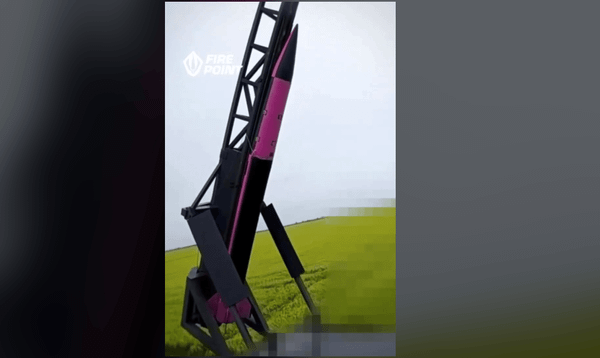
The tests took place recently, with the missile demonstrating a manoeuvrable and controlled flight
Ukrainian defence company Fire Point has released footage showcasing a test launch of the FP-7.X missile. According to the developers, the platform is intended to serve as the core architecture for the prospective FREYJA anti-missile interceptor system.
According to the company’s Chief Technical Officer, Iryna Terekh, the flight evaluation was conducted recently. She characterised the missile’s flight profile as highly manoeuvrable and fully controlled.
Fire Point noted that the FP-7.X is undergoing rigorous testing as an integral part of the ongoing development of the next-generation interceptor system.
Based on its designation, the surface-to-air missile appears to be derived from the FP-7 short-range ballistic missile announced by Fire Point in 2025.
Previously, Fire Point announced plans to create a unified, integrated air and missile defence system called FREYJA. Its primary purpose will be protection against ballistic threats.
The system will include the FP-7.X interceptor missile, which features a semi-active homing head from Diehl Defence. A technology cooperation agreement with the German air defence systems developer was signed in April of this year. Built from composite materials, the missile can accelerate to 1,500–2,000 m/s (or 5,400 to 7,200 km/h), measures 7.25 m in length and 1.15 m in outer diameter.
For the long-range radar detection system, the candidates under consideration are the Giraffe 8A/4A from Swedish company SAAB, the Ground Master 400 from France’s Thales, or the TRML-4D from Germany’s Hensoldt. The latter is already in service with Ukraine and operates as part of the IRIS-T SLM air defence system.
Fire Point also plans to start producing solid rocket fuel at its own facility in Denmark in 2026. Iryna Terekh says that construction of the plant is currently underway, while the company is also securing all required permits, including environmental and waste management approvals.
The first phase of the plant is scheduled to open in 2026, with the main phase likely to follow in 2027. The facility will produce rocket fuel, engine casings, and connecting components, as well as assemble rocket engines.
This article first appeared on Defender Media and is republished here with permission.