Last week, Swedish businessmen Pär Lager, Andreas Flodström, and Jonas Rydin announced the launch of Varangians, an investment group planning to commit €10 million to Ukrainian defence tech by the end of 2025. In an interview with Defender Media, Varangians CEO Pär Lager emphasised that this is only the beginning — if the group proves successful, the Swedes intend to invest tens of millions more euros into Ukrainian defence startups in the coming years. Crucially, the primary measure of success won’t be financial returns, but the impact these investments have on strengthening Ukraine’s defence capabilities. Lager also discusses why Nordic countries remain Ukraine’s strongest allies, which startups Varangians is targeting, and the group’s broader strategic vision.
Tell us a bit about your background and how the idea to launch the investment group came about.
In addition to other roles, I serve as a Senior Advisor at the Swedish Defence University and as an officer in the Swedish Armed Forces, where I’m responsible for lessons learned and support to Ukraine. My role involved analysing Ukraine’s wartime experience to update the education of Swedish officers. That meant spending a lot of time in Ukraine – interviewing political, business, and military leaders, conducting research, and visiting army units to understand what we can learn from your experience, and more importantly, how we can support Ukraine in the best possible way.
Sweden has already launched 19 support packages for Ukraine – including weapons, funding, and other resources – so this work has been incredibly important.
Spending time here, it’s heartbreaking to witness the war and the struggle, but also deeply inspiring to see the bravery, resilience, creativity, and immense talent that exists in Ukraine. It became clear to me that beyond military aid, Ukraine needs greater investment – both in capital and expertise, including joint ventures with Western companies.
That realisation turned me into a strong advocate for greater international investment in Ukraine. I started speaking across Europe, asking, “Why aren’t we seeing more investment in the world’s epicentre of defence tech innovation?”
As a result of that advocacy, a well-known Swedish family office approached Andreas Flodström and me with the idea of starting an investment group focused on Ukrainian defence tech. They offered to finance the launch and help bring in additional investors.
Pär Lager with Beetroot founder Andreas Flodström
My role, together with my partners, is to identify promising companies to invest in and support their growth. We started building this initiative from scratch in late March to early April – and things have moved quickly. We’re now fully operational and ready to invest.
What’s the story behind the name of the company?
We’re still in the process of registration, but the name we’ve chosen is Varangians. Ukrainians know this word – it refers to the Vikings who came here over a thousand years ago, helped build Kyiv alongside the local people, and later fought the Russians together. Now, we’re coming back.
We love the name and the history behind it. We share the same roots – Ukraine, Sweden, and the broader Nordic region have been connected for over a thousand years. I think that’s also why you see such strong support for Ukraine coming from the Nordics – maybe the strongest in the world.
How is the company structured? Why not a VC fund?
Because having a fund would mean more administrative work and slower processes. As an investment group, we can move faster and keep things more straightforward. We work exclusively with professional investors – family offices and similar groups – which makes operations both easier and more efficient. We’ve learned from Ukrainians that speed is essential. You can’t afford to be slow. A well-governed investment company can be much faster than a traditional fund.
How much money are you planning to invest?
This year, we plan to invest €10 million – and we intend to grow from there. We’ve already secured €2.3 million at the start and are actively bringing new investors on board as we speak. Once we reach the €10 million mark, our full focus will shift to deploying that capital.
After investing the first €10 million, we’ll start building the next investment group – Varangians 2, Varangians 3, and so on – each with a target size of €10 million.
The goal for this year is to establish a solid €10 million foundation. Future rounds will depend on our performance. If we deliver results together, we’ll attract more investors and continue growing.
What’s the ticket size?
It’s not too large – we will typically invest between €100,000 and €1 million per company.
Are you in talks with any Ukrainian startups already?
Yes, we currently have five startups in our pipeline. We’re actively working with all five, and two of them are in the final stages of due diligence. We expect to close deals with those two by the end of July.
Are you the only investor in their rounds, or are you part of a larger one?
We’re part of a larger rounds. We’ll be co-investing alongside other players – both Ukrainian and international investors. It’s important for us to join forces with strong partners. We believe that building this movement together is the way forward. Being alone doesn’t make you strong – collaboration does.
What’s your investment strategy? Can you tell us more about the criteria and focus areas for the startups you’re looking to invest in?
We focus on startups and scale-ups, typically from TRL (Technology Readiness Level) 5 or 6 and up. There needs to be a working prototype – we want to see that the technology functions and solves a real, immediate problem. That’s essential for us.
We’ve defined four main focus areas, although we’re not strictly limited to them:
Unmanned systems – and technologies that support them.
Electronic warfare (EW).
Demining technologies – both humanitarian and military.
Information warfare – especially tools to counter disinformation. We see this as a very real and dangerous form of warfare. I’m genuinely impressed with how Ukraine has handled Russian disinformation, and we’ve seen many promising solutions coming from here.
These are our core areas, but we remain open to other innovations within defence tech – such as smart communications equipment or advanced combat healthcare solutions. The key is that it must be defence-focused, innovative, and technologically advanced.
Are you willing to share which two startups are in the final stage of due diligence, or at least which areas they operate in?
Sure. Both startups are working in the field of unmanned systems and supporting technologies for unmanned platforms.
You mentioned that future iterations of the group will depend on the performance of the first, but isn’t it too early to expect any ROI this year?
That’s what sets us apart. For us, success isn’t just about financial returns – it’s about making a real difference for Ukraine. If we invest in companies that have a meaningful impact, that’s the true measure of success. But if we end up backing companies that don’t make a difference, then we haven’t succeeded, no matter the return.
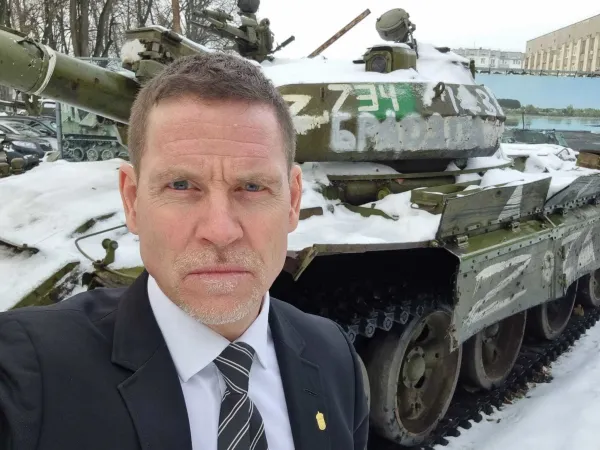
Pär Lager in Kyiv, Ukraine
We have three strategic pillars, and all of them are equally important. The first is to invest in defence tech that can rapidly support Ukraine in defending its territory.
The second is to help Sweden, the Nordic countries, and the rest of Europe rearm using Ukrainian expertise and Ukrainian-made systems. There are already some export opportunities, but this will also require further opening of arms export regulations. Our goal is to help Sweden, Finland, Norway, and Denmark rearm with some of the best defence technologies in the world, coming from Ukraine.
The third pillar is long-term economic sustainability. Naturally, our investors should get their money back, with some profit. That’s important too, but it comes third in line.
So, success in 2025 and 2026 will primarily mean finding strong Ukrainian companies to invest in, helping them scale, and enabling them to make a real difference in the war effort. If they can also contribute to the rearming of the Nordics and the rest of Europe, even better. Those are our top two priorities. The third is financial return.
Who will you be partnering with in Ukraine?
First of all, we’re not a massive investment group – and frankly, it’s a shame there aren’t more firms like us operating here at scale. One of our goals is to start a movement that encourages other investors to join. In fact, many investors have already approached us, asking if they can piggyback on our deals, since they’re not present on the ground in Ukraine.
Secondly, we also see ourselves as bridge builders between Ukrainian companies and Nordic firms – facilitating joint ventures, co-production, and long-term partnerships. So it’s not just about investing; it’s also about creating connections.
To do that, a strong local network is essential. Since the beginning, we’ve been working closely with Brave1, the Iron Cluster (we signed a memorandum of cooperation with them two weeks ago), and many other key players in the ecosystem.
With the IRON Cluster team
Having a strong presence in Ukraine is critical for understanding the market and identifying the right companies. Andreas, for example, has a well-established reputation and network after 12 years of working in Ukraine. On my side, I’ve built strong relationships within the Ukrainian military – collaborating with the military academies, the National Defence University in Kyiv, and frontline units, including the National Guard.
How do you divide responsibilities between the three founders?
Andreas is our tech expert – he’s been living in Ukraine for 12 years and brings deep knowledge of the local ecosystem. He’s also a successful entrepreneur and serves as Chairman of the company. His focus is on technology and the Ukrainian context.
Jonas has a strong background as both an investor and entrepreneur. He’s the chairman and owner of two Swedish defence tech companies, has military experience – just like I do. He brings a combination of defence industry expertise and operational understanding, as well as a solid connection to Ukraine.
As for me, my main focus is on the military side – that’s my background and what I’ve studied intensively in recent years. I’m also an active reservist in the Swedish Armed Forces. As CEO, I manage the company’s operations and strategy, but my primary responsibility is identifying companies that solve real and urgent military problems.
Will you expand your team?
Yes, we plan to hire people here in Kyiv. We already have an office and we’re working closely with Beetroot, which has offices throughout Ukraine. Our next hire will likely be a person based in Kyiv – someone who can help track and evaluate leads, support ongoing collaboration with startups, and conduct in-depth research to identify promising companies and emerging domains in defence tech.