
Courage comes in two colours. How Ukrainian-Swedish cooperation in defence tech is evolving
The joint project for drone AI, SOFF delegation, and Defence Builder’s new advisor

– 6 min read
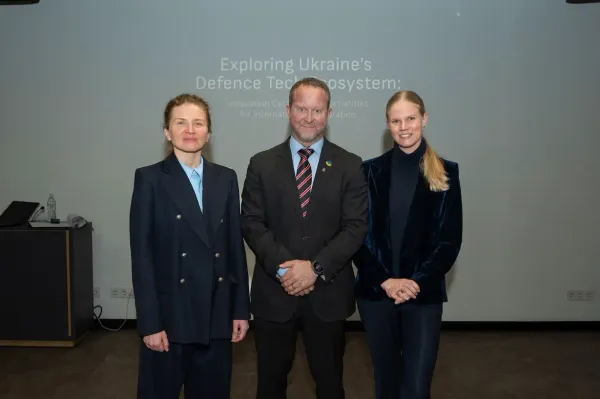
The joint project for drone AI, SOFF delegation, and Defence Builder’s new advisor
This spring, one topic has dominated conversations at Ukrainian defenсe events: Europe’s awakening. At the forefront of this shift are the Scandinavian nations—now among Ukraine’s closest allies. And within that group, Sweden stands out. March 2025 saw a series of developments that signal a deepening partnership between Ukraine and Sweden in the field of defence tech. Defender takes you inside the story.
On March 31, Swedish Defence Minister Pål Jonson unveiled a landmark $1.6 billion aid package for Ukraine—the largest military support package Sweden has committed so far. A significant share of the funding will go toward acquiring equipment and ammunition from Swedish defence manufacturers. Meanwhile, over $500 million is set aside to support Ukraine’s domestic defence industry by “Danish model.”
One line item that especially caught Defender’s eye—despite its relatively small size—is the $1.1 million earmarked for the joint development of AI technologies for drones. The details remain under wraps, but the project aligns with a broader strategic push by Ukrainian officials to advance state-level AI initiatives for defence and beyond. Among those plans: a Ukrainian large language model (LLM), which the Ministry of Digital Transformation aims to launch by late 2025. Once operational, the national LLM will enable secure, domestic data processing—crucial for AI-powered defence applications.
In the latter half of March, a high-level Swedish delegation touched down in Kyiv, signaling deepening ties between the two countries’ defence sectors. Organized by the Swedish Security and Defence Industry Association (SOFF), the visit brought together representatives from Sweden’s Ministry of Defence and some of the region’s top defence and tech companies. On the guest list: Scandinavian Astor Group, BAE Systems Bofors, BAE Systems Hägglunds AB, Beetroot, MilDef, MW Group, Ovzon, Saab, Scania Group, SRS Security, SNIGEL, Vesper Group, Volvo Defence, and W5 Solutions.
Hosted at the Kyiv office of Sigma Software, the delegation attended a joint event by the Defence Builder accelerator and Brave1—the state-backed national defence tech cluster. There, Swedish guests were introduced to the Ukrainian defence innovation ecosystem and heard pitches from seven homegrown startups working on cutting-edge battlefield technologies.

SOFF, for its part, isn’t stopping there. Several more visits are already in the works for 2025, with a focus on key defence tech verticals like autonomous systems, drones, and secure communications.
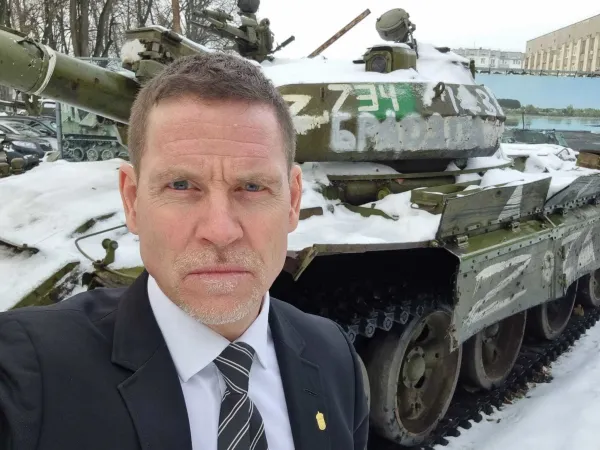
Among the Swedish delegates visiting Kyiv this spring was Jonas Rydin—NCO in the Swedish Marines, entrepreneur, investor, and now advisor to Ukraine’s Defence Builder accelerator.
Rydin is no newcomer to the business. He launched his first venture in 1995, and a decade later co-founded an investment company with his wife. Since then, he’s backed over 50 projects and made more than 25 successful exits, including IPO. His portfolio includes co-founding the Swedish defence firm W5 Solutions and investing in several other defence ventures.
His connection to Ukraine began not with business but with solidarity. In 2022, he founded Quartermaster for Ukraine, a charity that has since delivered over $20 million in aid to the Ukrainian Armed Forces—ranging from medical kits and radios to drones and trucks.

But Rydin sees Ukraine not just as a recipient of help but as a hub of world-class innovation. “No army in the world has ever had to adopt and refine new technologies as quickly as the Ukrainian Armed Forces,” he told Kyiv Post. That breakneck pace, he believes, is what makes Ukrainian defence startups especially promising to international investors.
With a deep talent pool, strong technical education, and hundreds of thousands of people with combat experience, Ukraine is uniquely positioned to lead in key defence sectors—from unmanned systems and cyber warfare to electronic warfare and anti-jamming tools. And Jonas Rydin is betting that investors in the West will soon see the same potential he does.
Seven Ukrainian startups—ranging from experienced players to newcomers—pitched their solutions to the SOFF delegation.
Moodro specializes in portable anti-drone systems. Its product line includes an FPV countermeasure system, a six-channel EW system, a portable FPV detector, and the autonomous anti-drone solution Spectrfy. Moodro collaborates with the Main Directorate of EW, the Security Service of Ukraine (SBU), the Ministry of Internal Affairs special unit “KORD,” and instructors from the “Borivyter” school. The company was founded by Nataliia Ohienko.
Frontline Robotics develops robotic systems for automating military operations. Their portfolio includes ground robots, drones, turrets, and full-cycle combat software—from reconnaissance to reporting. Products include the lightweight Linza bomber drone, Zoom reconnaissance drone, the Burya grenade launcher turret, and the Hertz control module. Co-founders: Yevhenii Tretiak, Oleksii Markhovskyi, Pavlo Kosolapkin, and Oleksandr Ostapenko.

Ratel S founders initially worked in street lighting but pivoted to defence robotics after the beginning of full-scale invasion. Their core product is the Ratel-S ground robotic system for remote mining. Other developments include the Ratel Deminer, medical stretchers, and a robotic nurse platform. In spring 2024, a Ratel kamikaze robot was used to destroy bridges in Donetsk region, disrupting Russian logistics.
Technohawk focuses on designing and manufacturing FPV drones and large UAVs with a payload capacity of over 20 kg. Their technology supports modern armored forces by enhancing combat and logistical capabilities through advanced autonomous systems.

Ratel S founders initially worked in street lighting but pivoted to defence robotics after the beginning of full-scale invasion. Their core product is the Ratel-S ground robotic system for remote mining. Other developments include the Ratel Deminer, medical stretchers, and a robotic nurse platform. In spring 2024, a Ratel kamikaze robot was used to destroy bridges in Donetsk region, disrupting Russian logistics.
Technohawk focuses on designing and manufacturing FPV drones and large UAVs with a payload capacity of over 20 kg. Their technology supports modern armored forces by enhancing combat and logistical capabilities through advanced autonomous systems.
Falcons, founded in 2022, builds hardware-software solutions to boost operational efficiency. One of their key products, ETER, is a tactical-level radio signal locator. It’s rapidly deployable, integrates into networks, and provides critical situational awareness for units operating in complex environments.
Armor is a team that has been collaborating with the Ukrainian military since 2014. Their flagship product is the Armor mobile app—a tactical system that increases weapon system efficiency. It allows hidden-position targeting with high accuracy using tanks, IFVs, mortars, and more. The app factors in ballistics data like temperature, air pressure, and ammunition weight. It’s funded by the “Come Back Alive” Foundation.
Farsight Vision offers geospatial analytics and digital twin generation, delivering real-time situational awareness through drone-captured footage and imagery. Their platform allows interaction with 3D models and orthographic images to track map changes. It supports construction planning, delivery logistics, and more—benefiting both military and civilian use in land management and monitoring. The platform enhances digitization and helps operators make informed decisions.

Farsight Vision’s business development manager, Oleksii Lytvynenko, says Sweden is one of the few countries that demonstrates both clear public support and real action for Ukraine.
“Courage comes in two colours — blue and yellow,” he resumes.
Published in partnership with Defender Media.